


Regenerative Agriculture as an Alternative to the Threat of Green Grabbing in Carbon Trading
Author: Muhammad Ezra Hanif & Annisa Inayatullah
The massive conversion of forests into monoculture agricultural land has resulted in a simultaneous climate and food crisis. Forest conversion has increased greenhouse gas emissions, thereby exacerbating the climate crisis.
Data from Global Forest Watch indicates that in 2020, Indonesia had 94 million hectares of natural forest, covering more than 50% of its land area. By 2024, it is expected to have lost 260,000 hectares of natural forest, equivalent to 190 Mt of CO₂ emissions. Between 2001 and 2016, oil palm monoculture accounted for 23% of national agriculture. Not only oil palm, but rice field cultivation programmes also bring a monoculture agricultural paradigm that will contribute to land cover loss.
In view of these conditions, the Conference of the Parties (COP) 30 meeting in Belem, Brazil, brought a breath of fresh air. The President's Special Envoy for Climate and Energy, Hashim Djojohadikusumo, committed to participating in the Tropical Forest Forever Facility (TFFF) initiative for financing tropical forest conservation.
The government's target followed this commitment to recognise 1.4 million hectares of customary forests over the next four years. To realise this, the Indonesian Minister of Forestry, Raja Juli Antoni, established a Task Force for the Acceleration of the Determination of Customary Forest Status.
In his article in Kompas, Raja Juli views forests as having an ecological function while also providing opportunities for people's welfare. As such, he believes that local communities must be involved as actors in green economic development efforts.
Recently, the government has been eyeing Indonesia's forests, particularly their potential to generate carbon credits. This is reflected in the plan to control climate change in the forestry sector through Indonesia's Forestry Land Use (FOLU) NET Sink 2030. FOLU NET Sink 2030 is expected to be an important pillar in the development of the global carbon market.
In other words, the Indonesian government is clearly enamoured by the economic potential of forests generated by carbon trading. This is especially true given the substantial funding from the TFFF, which amounts to US$4 per hectare of forest that is successfully preserved or improved.
Under this logic, the state's recognition of customary forests is not only based on the spirit of climate protection and the preservation of the human ecosystem with nature. The tendency is limited to economic gain, so nature is seen only as a commodity rather than part of a civilisation's identity that contains ecological values. This logic may be sound from a development perspective, but it carries the risk of conflict between parties, particularly the state and indigenous communities living around the forest.
This is because TFFF conservation funding is an investment. This means that there will be capital ties binding investors, the state and indigenous peoples. For Fairhead et al. (2012), this situation could lead to green grabbing. Green grabbing occurs when an area or land is controlled and regulated under the pretext of protecting nature and mitigating climate change, but on the other hand, principles exclude and even restrict the surrounding community.
In Kalimantan, the Dayak people are prohibited from farming on their own land because carbon projects consider it destructive to the forest. This prohibition has been met with resistance from the Dayak community, as clearing the forest by burning (known as sonor) is considered a tradition that has been practised for generations.
In Mount Elgon, Uganda, the REDD+ project violently evicted the Benet community. The area was designated a National Park, resulting in the Benet people being beaten, shot at, and having their crops uprooted under the pretext of protecting the forest.
This phenomenon reflects a paradox in efforts to mitigate the climate crisis. On the one hand, forest conservation is considered a positive step in curbing deforestation, but on the other hand, it has the potential to exclude local communities from their livelihoods.
From David Harvey's perspective, this can occur due to the interests of capital accumulation that underlie any development in any sector. Harvey calls this accumulation by dispossession, whereby public goods are privatised and commodified in order to open up space for capital expansion. State actors must guarantee this process, either subtly or violently through the use of armed forces.
Within this framework, the recognition of customary forests may be a form of state effort to facilitate global capital expansion. In fact, it may be to ensure that these areas can generate accumulation through carbon trading.
Therefore, capital ties in the carbon market have the potential to marginalise local communities. This is especially true with the existence of the Forest Area Control Task Force, which threatens local agroforestry activities, making the status of indigenous peoples, even after their land has been recognised, potentially vulnerable.
Development projects should not allow this to happen. We believe that alternatives that favour indigenous peoples are needed, so that they are not forced to shift their economic activities for the sake of carbon. The latter is indeed the most difficult challenge. The Indonesian Ministry of Forestry also recognises the importance of empowering local communities after the designation of customary forests.
We offer an organic farming scheme integrated into a fair carbon trading mechanism. Using the circular economy concept pioneered by Indian scientist Vandana Shiva, we see that organic farming opens up opportunities for more inclusive and sustainable decarbonisation.
Circular Economy: Sustainable Agriculture and Increased Carbon Sequestration
Natural carbon sequestration occurs through the process of photosynthesis by plants. First, carbon dioxide is absorbed from the atmosphere with the help of sunlight through photosynthesis.
Through this process, carbon returns to the biosphere, including plant biodiversity and soil biodiversity. This is the natural carbon cycle. Climate change is the result of a disruption in the carbon cycle caused by industrial growth.
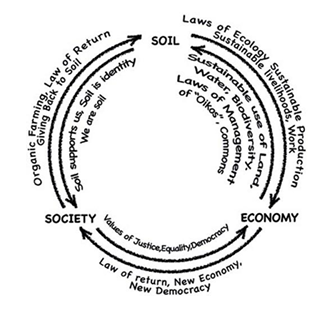
Figure 2. Circular Economy Logic
Source: Navdanya International
To implement this, we can use a circular economy based on a diverse, chemical-free, and self made local food system. The circular economy emphasises the reciprocal relationship between the land, the economy, and society. The land is believed to be a living entity that supports the economy and society. Meanwhile, the economy must be rooted in ecosystems that implement sustainable production. The relationship between the economy and society is bound by the values of justice, equality, and democracy. Then, society returns the results to the land. These three elements are bound together by the law of reciprocity to maintain the harmony of the ecosystem.
With the implementation of this system, emissions from fossil fuels and fossil chemicals used in the production process will decrease. This includes long-distance transportation and energy intensive industries. Agriculture based on the principles of the circular economy will return organic particles to the soil. This enables a reciprocal relationship between soil organisms and plants. As a result, photosynthesis increases, which in turn enhances the natural carbon cycle. The degenerative cycle is transformed into a regenerative cycle.
Healthy soil rich in organic particles, such as mycorrhizal fungi, will absorb more carbon dioxide from the atmosphere. These fungi can absorb 30 per cent of emissions.
Earthworms are also important drivers of microbes for life. The return of organic matter to the soil increases soil nitrogen, which helps in the formation of chlorophyll.
Maximising photosynthesis and returning carbon to the soil can absorb 34.74 gigatonnes of CO2 per year. A 10 per cent increase in the scale of various regenerative agricultural systems can contribute significantly to achieving negative emissions towards limiting global warming to 1.5°C above pre-industrial levels.
Regeneration and intensification of biodiversity allow us to grow a variety of foods. The more diversity we incorporate into the circular economy, the more fertile the soil will be. Also, the more plants there are, the more tools there are to recycle and repair atmospheric carbon and nitrogen.
One form of regenerative agriculture is agroforestry, the concept of planting crops in a manner similar to a forest. Agroforestry systems can maintain a sufficiently high diversity of tree species and populations. Diverse canopy strata have very important functions, namely the potential to store carbon, shade crops to reduce evapotranspiration, control erosion, and maintain nutrient cycles.
With tree diversity and large land cover, carbon reserves tend to be higher because larger and more diversified trees store more carbon through natural carbon processes. The carbon absorption potential based on forestry practices also indicates that agroforestry and plantation forests in tropical countries have a large potential of 6.3 and 16.4 GtC.
Regenerative agriculture is most often practised by indigenous peoples. Indigenous peoples' connection to the environment gives them knowledge about how to manage nature. According to a National Geographic report, indigenous peoples, who make up less than 5% of the world's population, protect 80% of biodiversity.
In practice, there are umo talang that are used as agroforestry fields by the women of Batin, Bujang Raba, Jambi. In the past, umo talang were created in the middle of the forest, with an average size of 2 hectares, far from villages and usually located on riverbanks, and planted with rubber, secondary crops and now even coffee and cocoa. This system allows for the restoration of nutrients while preserving the ecosystem.
By maintaining this agricultural system, the Bujang Raba community can still participate in carbon trading through a community-based carbon scheme regulated under Principle 6.4 of the Paris Agreement. Evidently, the 5,339 hectares of forest they manage effectively produce zero carbon emissions. The community's initiative continues to be supported by the Indonesian Conservation Community (KKI) Warsi, which focuses on assisting communities in sustainable forestry. KKI Warsi has played an important role in exploring voluntary carbon market opportunities since 2015.
As a result, Bujang Raba successfully accessed the community carbon credit scheme through Plan Vivo. Carbon credit buyers came from market players in Europe, including an institution from Sweden, through Zero Emission. This effort yielded Rp 3.5 billion in the 2018-2020 period. In 2019, the result was IDR 400 million, and in 2020 it reached IDR 1 billion.
This opportunity can maximise carbon trading, which will later be managed by indigenous peoples. This effort needs to be supported by a mechanism for the distribution of group forest ownership rights by the Ministry of Forestry. This will empower indigenous peoples on their own land. Instead, this mechanism will prevent them from being excluded from the land distributed by the Ministry of Forestry.
Conclusion
Carbon trading as a solution to the climate crisis needs to be implemented fairly. REDD+ cases have been shown to result in accumulation by dispossession, driving indigenous peoples from their own forests. This is inseparable from the state's logic of viewing forests as commodities.
The circular economy that has long been applied by indigenous peoples can be an alternative. In addition to retaining their land, indigenous peoples can also actively participate in carbon trading through community-based carbon schemes. Land from regenerative agriculture has been proven to sequester more carbon. Therefore, this offer can be an effort to stop the accumulation of dispossession and support carbon trading in Indonesia.


